
Insight
The Algorithm in Your Cup: What AI Can — and Can’t — Do to Coffee
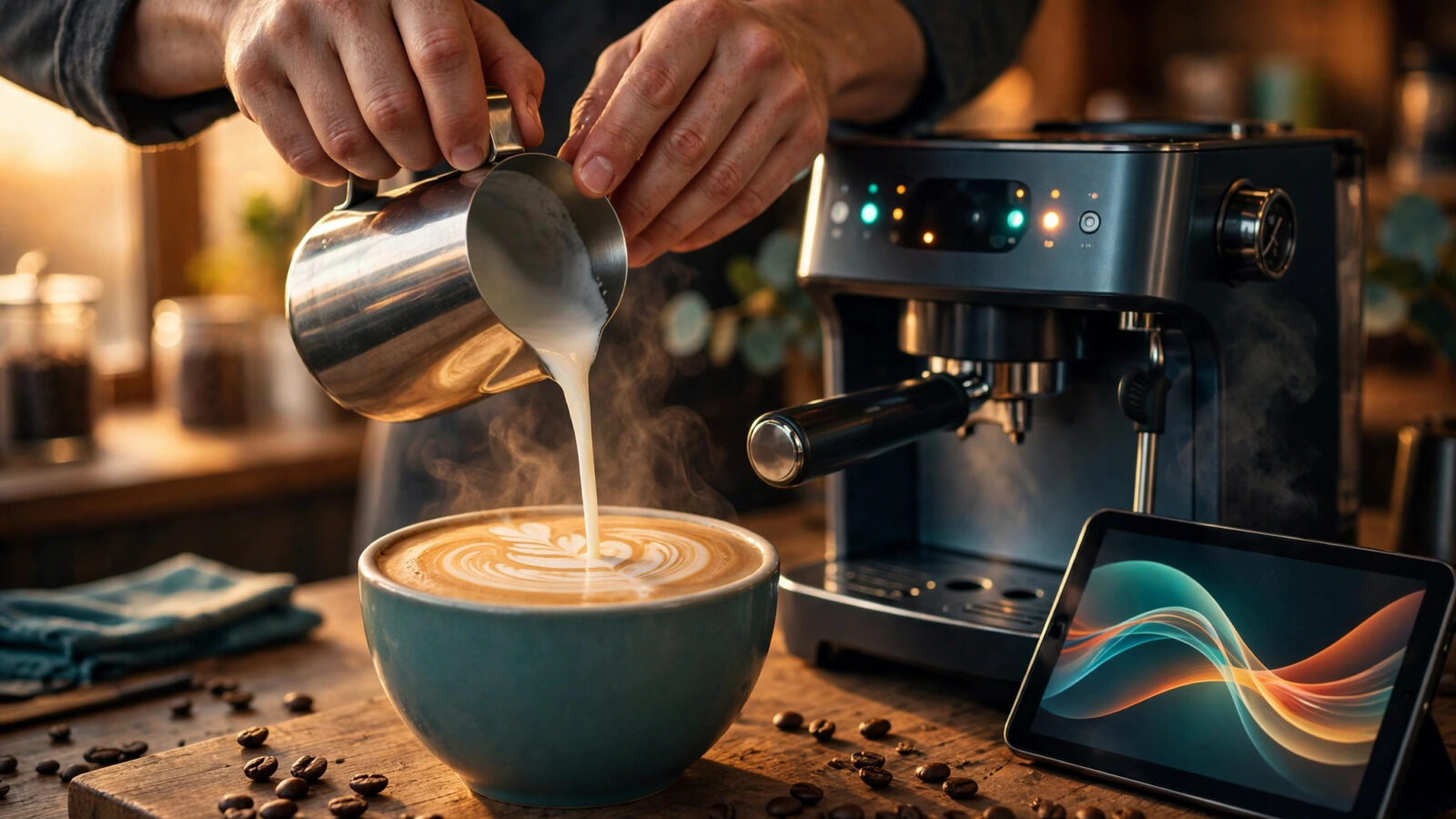
Coffee is humanity’s oldest productivity technology. Before the pitch deck, before the stand-up meeting, before the all-nighter — there was a bean, hot water, and a ritual. So it’s only fitting that the newest technology we have, artificial intelligence, is now pouring itself into every layer of the cup: the farm, the roast, the brew, the brand, and the strange, stubborn human experience we call taste.
The interesting question isn’t whether AI can make coffee better. It’s which parts of coffee were ever about the coffee.
Act one: the bean gets smart
Start where coffee starts. On farms, machine-learning models now flag leaf rust and other crop diseases from photographs before the human eye can see them, and yield forecasts blend weather, soil, and satellite data into harvest predictions that shape global prices. At the roastery, sensors track bean temperature, airflow, and rate-of-rise hundreds of times per roast, and profiling software learns the curve that produced the cup the roaster loved — then reproduces it, batch after batch, with a consistency no human wrist ever had.
None of this is magic, and all of it matters. Coffee quality used to be a lottery of weather, instinct, and luck. AI is quietly converting it into an engineering discipline. The floor rises: bad coffee gets harder to make by accident.
But notice what the machines are optimising: consistency, yield, defect rates. Measurable things. The measurable is where AI lives. Coffee, inconveniently, is only partly measurable.
Act two: can an algorithm taste?
Taste is the last analog frontier, and it’s worth being precise about why.
A coffee’s chemistry is genuinely knowable — hundreds of aromatic compounds, acids, sugars, and oils that instruments can measure far more sensitively than your tongue. Researchers have trained models on that chemistry to predict how trained tasting panels will score a cup, and the models do surprisingly well. Subscription services like Trade Coffee built their businesses on a humbler version of the same idea: a matching algorithm that learns your palate from what you rate and predicts what you’ll love next. Starbucks runs its own personalisation and operations platform, Deep Brew, deciding offers, staffing, and machine maintenance across thousands of stores.
So yes — an algorithm can model taste. It can learn that you like bright, acidic Ethiopian coffees and dislike smoky dark roasts, often before you can articulate it yourself.
What it cannot do is have the experience. Taste isn’t a measurement; it’s a memory with a mouth. The cup that tastes like your grandfather’s kitchen, the espresso that tastes like the trip where everything went right — no model has access to that dataset, because the dataset is your life. AI can predict preference. It cannot manufacture meaning. And in coffee, meaning is most of the product.
People don’t buy coffee. They buy the ten minutes the coffee gives them.
Act three: the ritual resists optimisation
Here’s the paradox the industry keeps bumping into. Coffee’s value was never mainly caffeine delivery — caffeine is available in pill form, cheaper and faster, and almost nobody chooses it. Coffee’s value is the pause: the morning ceremony, the café as a third place between home and office, the meeting that happens because two people needed an excuse.
AI is magnificent at removing friction. But the ritual is friction — grinding, waiting, watching the bloom, carrying the cup to the same seat. Optimise all of it away and you haven’t perfected coffee; you’ve deleted it and kept the caffeine. The robot-barista kiosks now pouring lattes in airports and malls are a genuine marvel, and they prove the point by contrast: they sell speed to travellers. Nobody writes poems about them. The café you love survives precisely because a human hands you the cup and knows your name — or at least your order, which in the morning amounts to the same sacrament.
The ritual is friction. And the friction is the product.
There’s a subtler risk, too: the palate echo chamber. Recommendation engines give you more of what you already like. That’s comfortable — and it’s how tastes stop growing. Every serious coffee drinker’s palate was built by accidents: the weird cup someone handed them, the origin they’d never have chosen. An algorithm trained on your past preferences is a conservative curator. Left alone with it, your taste doesn’t sharpen; it narrows, beautifully optimised into a smaller and smaller room.
Act four: branding in the age of infinite sameness
Now the marketing problem, and it’s a real one. When every brand has access to the same AI — the same copy generators, the same image tools, the same personalisation engines — capability stops differentiating anyone. The tools are table stakes. What remains scarce is the thing AI produces worst: a point of view.
Watch what the smart coffee brands actually sell. Not beans — identity. The roaster’s obsession, the farm’s name, the founder’s stubbornness about a roast level everyone said was wrong. AI can generate a thousand on-brand captions before breakfast, but a brand isn’t captions; it’s a set of decisions someone was willing to defend. The brands winning the AI era will use the machines for everything measurable — media buying, inventory, retention offers, the Deep Brew playbook — while keeping the story defiantly, expensively human. Because when content is infinite, taste — the brand’s taste, exercised in public — becomes the only moat left.
And there’s a data twist hiding under the counter. Connected brewers and app-driven subscriptions turn coffee into an information business: who drinks what, when, how strong, how often they run out. The most valuable asset in the future coffee company may not be the roast profile. It may be the palate graph — the map of a million individual tastes, learned one morning at a time. Whoever owns that map owns the recommendation, and whoever owns the recommendation owns the customer.
The last inch
So pour the whole picture together. AI will raise the floor of coffee — better farming, eerily consistent roasts, a new bag arriving the day before you run out, matched to a palate it knows better than you do. It will run the business of coffee better than the business of coffee has ever been run.
And the ceiling? The ceiling stays human. The ceiling is the roaster who tastes something the sensors didn’t flag and bets the season on it. The barista who reads your face and adjusts the shot. The friend who hands you a cup from somewhere you’ve never heard of and ruins your old favourite forever. The ten unoptimised minutes in which the day gets decided.
AI can do almost everything to coffee except the thing coffee was for.
Which is fortunate — because it means the best seat in the café is still yours.
Now finish your cup. It’s getting cold, and no algorithm can save it from that.
Keep reading

Fear & Greed Just Hit 10. Here's What Happened the Last 5 Times.
The Crypto Fear & Greed Index printed 10 this weekend — Extreme Fear, about as scared as this market gets. It printed 10 on…
Explore
Is Crypto Cooked? Bitcoin Is Down 46% From Its High — Here's What the Data Actually Says
Every group chat in crypto is asking the same question this weekend, so let's ask it properly: is crypto cooked? Not "is the chart…
Explore
Stop Doing It Manually: The Martini Labs AI Agent Operating System Is Here
Your business is doing work a machine should be doing. The Martini Labs AI Agent Operating System is live — a free checklist, a $17 guide, a $27 audit, and the complete 369-page flagship bundle. Meet MAX and climb the ladder from Manual to Autonomous.
Explore
Save the Trenches: A Field Manual for Making Crypto Respectable Again
The trenches don't need saving from speculation — they need saving from extraction. Fair launches, honest launchpads, a real anti-rug toolkit, and the community models that outlast the drawdowns.
Explore
Weekly · Free
The Martini Shot
One shot of AI, crypto and future-tech signal every week — what matters, why it matters and what MAX thinks.
No spam. Unsubscribe any time.