
Insight
The Robots That Actually Arrived Weren’t Humanoid
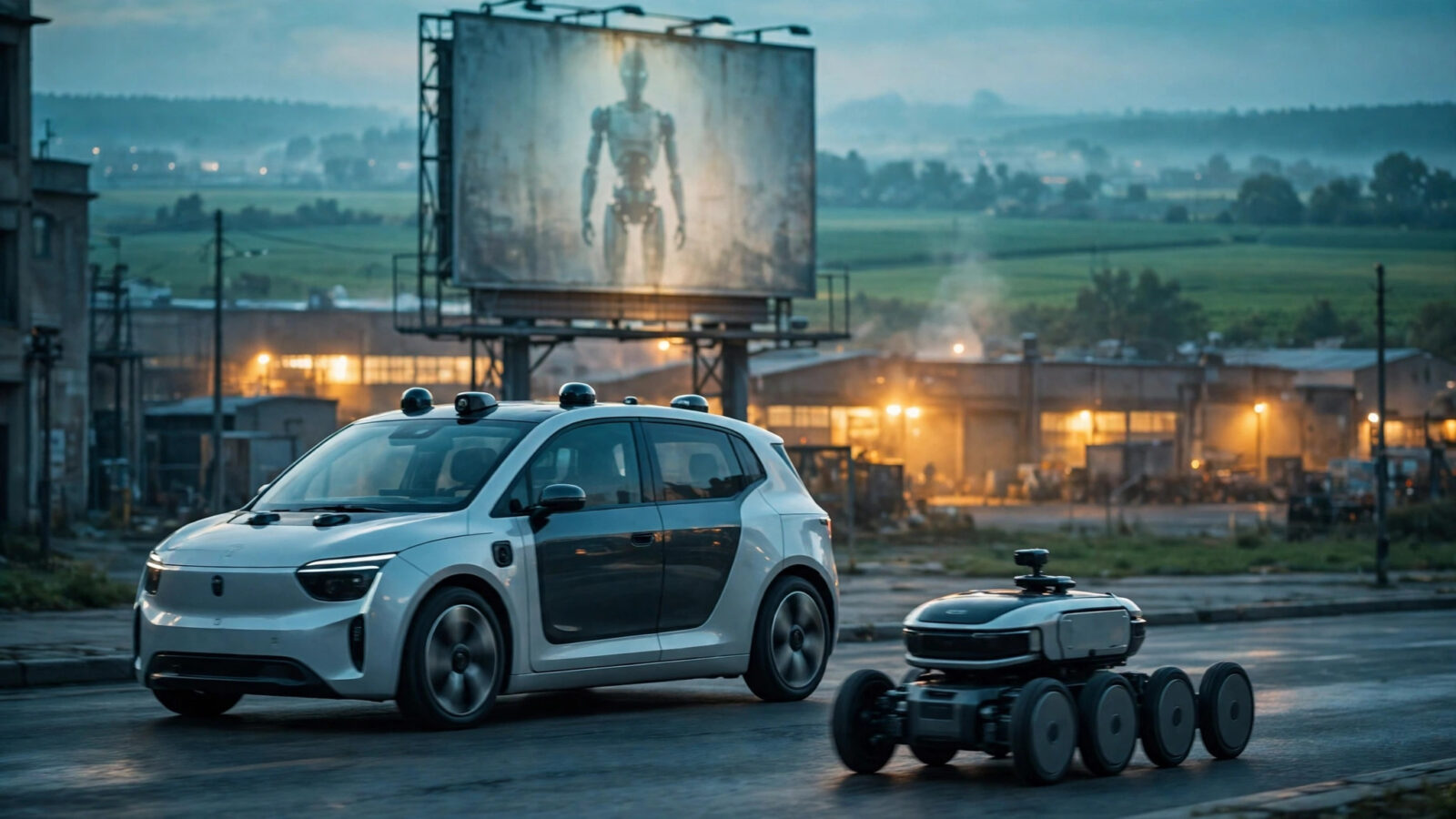
If you judge robotics by its keynotes, the future walks on two legs, waves at the crowd, and does a backflip. If you judge it by its invoices — paid rides, completed deliveries, operating hours, contracted backlogs — a completely different industry shows up. The robot revolution did not fail to arrive. It arrived on wheels, at 25 miles an hour, carrying somebody’s lunch, and almost nobody filmed it because there was nothing to film. It just looked like work.
That gap between the demo and the deployment is the most mispriced story in tech. Here is the scoreboard the keynotes don’t show you.
The scoreboard: half a million paid rides a week
Waymo is the most important robotics company in America and it does not make a robot you can point at. Its last disclosed figure — 500,000 paid, fully driverless rides per week, reported by Alphabet in April 2026 and still the number its briefings cited in November — runs on a fleet of more than 4,000 vehicles across 15 US metros, with over 300 million fully autonomous miles logged. It completed 15 million rides in 2025 alone and has targeted a million rides a week by the end of 2026, a goal independent forecasters doubt it hits on schedule — which tells you the argument is now about the speed of the scaling, not whether the business exists.
The rest of the field shows the gap. Tracker counts in mid-November put roughly 670 Tesla robotaxis deployed driverless in the US — real, growing, and about fifty-fold behind on fleet. In China, Baidu’s Apollo Go peaked above 350,000 fully driverless rides a week in March 2026, though that figure was never established as paid-only. Nobody in this paragraph has legs. Every one of them has a fare box, a dispatch system, and a cost per mile that either works or doesn’t. That is what a robotics business actually looks like.
A million robots nobody has seen
The largest robot fleet on Earth works indoors and has never been on a stage. Amazon deployed its one-millionth warehouse robot in mid-2025 and by late 2026 operated more than a million across its fulfillment network — overwhelmingly wheeled mobile units that glide inventory pods to human workstations, coordinated by an AI fleet model that Amazon says cuts fleet travel time by about a tenth. Roughly 75 percent of Amazon’s global deliveries are now robot-assisted. The arms with names — Robin, Cardinal, Sparrow, Vulcan — number in the thousands and handle picking and packing; the anonymous wheels handle the volume.
Zoom out and the pattern is the industry. The International Federation of Robotics counts about 4.66 million industrial robots in operation worldwide, with roughly 542,000 installed in 2024 alone, and nearly 250,000 professional service robots sold in 2025, up 24 percent. Symbotic reports a contracted backlog in the tens of billions. This is the installed base of the robot age: not bipeds, but fleets — bought on payback periods, depreciated on schedules, and expanded because the spreadsheet said yes.
The sidewalk economy
The most quietly successful consumer robots in the world are insulated coolers doing three miles an hour. Starship Technologies passed 10 million autonomous deliveries in April 2026, running more than 3,000 robots across some 300 locations in eight countries — campuses, suburbs, city districts — and cites a cost advantage of $3 to $4 per delivery against a human courier, with a long-term target near a dollar. Serve Robotics has deployed more than 2,000 sidewalk robots across US metros including Los Angeles, Atlanta, Dallas–Fort Worth, Miami and Chicago, delivering for Uber Eats and DoorDash at a reported 99.8 percent completion rate. Coco Robotics has passed half a million deliveries. Above them, the same logic with rotors: Walmart and Alphabet’s Wing are expanding drone delivery to 150 more stores.
Notice what these businesses sell. Not robots — deliveries, at a price per drop, with the fleet and the maintenance bundled in. The customer never thinks about the machine. That invisibility is the tell that the technology has crossed from novelty to infrastructure.
Dirt, crops, and clipboards
The pattern repeats wherever the environment is structured and the labor is scarce. Ecorobotix has deployed 1,000 of its ultra-precision sprayers worldwide — machines that see weeds and spray plants individually instead of drenching fields. Autonomous spraying fleets treated 4,265 hectares across Norway, Sweden, Germany, the Netherlands and Australia in the first seven and a half months of 2026 alone, and US growers have put autonomous tractors to work at commercial scale, including the largest such deployment in the American sugar industry. Inspection drones and crawlers patrol pipelines, solar farms, and inventory warehouses nobody wants to count by hand.
None of these machines looks like a person, because none of their jobs was shaped like one. A field is not an office. A warehouse aisle is not a kitchen. The jobs were redesigned — or were always mechanical — and the robot was built to fit the job, not the other way around.
Why wheels beat legs
Three reasons, all of them economics. First, environments: a warehouse floor, a geofenced campus, a mapped suburb can be arranged around the robot, while the humanoid’s whole pitch is surviving spaces built for humans, unmodified — the hardest possible version of the problem, priced accordingly. Second, cost per completed task: a mobile robot running twenty hours a day at a five-figure price amortizes to nearly nothing per move; a humanoid’s purchase price, maintenance, and supervision have to beat a human wage at human flexibility, a far higher bar. Third, failure cost: when a delivery bot gets stuck, a remote operator nudges it free and lunch is four minutes late. Nobody’s keynote depends on it.
And the humanoids? They are real, and they are early — those are compatible statements. Agility’s Digit has logged more than 65,000 operating hours across nine customer facilities moving totes, with an order book reported above $300 million: genuine commercial work, and still roughly three orders of magnitude below the operating hours of the wheeled fleets. Figure deployed on the order of 150 units in 2025 against commitments of 100,000 over four years. Mid-2026 deployment scoreboards counted zero production Tesla Optimus units against targets in the tens of thousands. China’s Unitree and AgiBot each shipped five thousand-plus humanoids in 2025, largely into research, development, and data collection rather than paid shifts. Humanoids are a long-dated option on general-purpose labor. Options can pay off enormously. They are just not the business that exists today.
What it means if you’re building or investing
Follow the disclosures, not the demos. The metrics that matter in robotics now are the boring ones: paid rides per week, deliveries completed, operating hours, contracted backlog, cost per task against the human alternative. By those metrics, the winners of the robot era so far are fleet operators and the software that coordinates them — dispatch, fleet intelligence, remote operations, maintenance — the layer where a 10 percent efficiency gain across a million machines is worth more than a backflip.
For operators, the actionable version is simpler: the automation that pays in 2026 is the kind that already exists, in fleets, at a price per task, in environments you control. The winning robot of 2026 doesn’t look like a person. It looks like a business model. If you want to find where that model fits inside your own operation — which workflows are structured enough, scarce enough, and expensive enough to hand to the machines that actually arrived — that’s exactly the exercise the AI Automation Opportunity Finder ($27) walks you through, task by task, with the ROI math done honestly.
Keep reading

Can a Tokenized Community Keep People Around After the Rewards Stop?
Run one cycle with rewards and one without. Then measure who still shows up to do something another member values. Imagine a group that…
Explore
Stablecoins Are the Internet's Checking Account Now
Here is a number that looks like bad news: there are fewer stablecoins in the world than there were six months ago. Total supply…
Explore
ANT Opened at $111.50 — a 34% Pop. Then It Gave a Third of It Back.
Anthropic's first trade printed at $111.50 — and then the market started selling. After pricing at $83 a share on Wednesday evening — above…
Explore
When Every Brand Has the Same AI, the Only Moat Left Is a Point of View
Yesterday, writing about what AI can and can't do to coffee, we landed on a line that deserves its own article: when every brand…
Explore
Weekly · Free
The Martini Shot
One shot of AI, crypto and future-tech signal every week — what matters, why it matters and what MAX thinks.
No spam. Unsubscribe any time.