
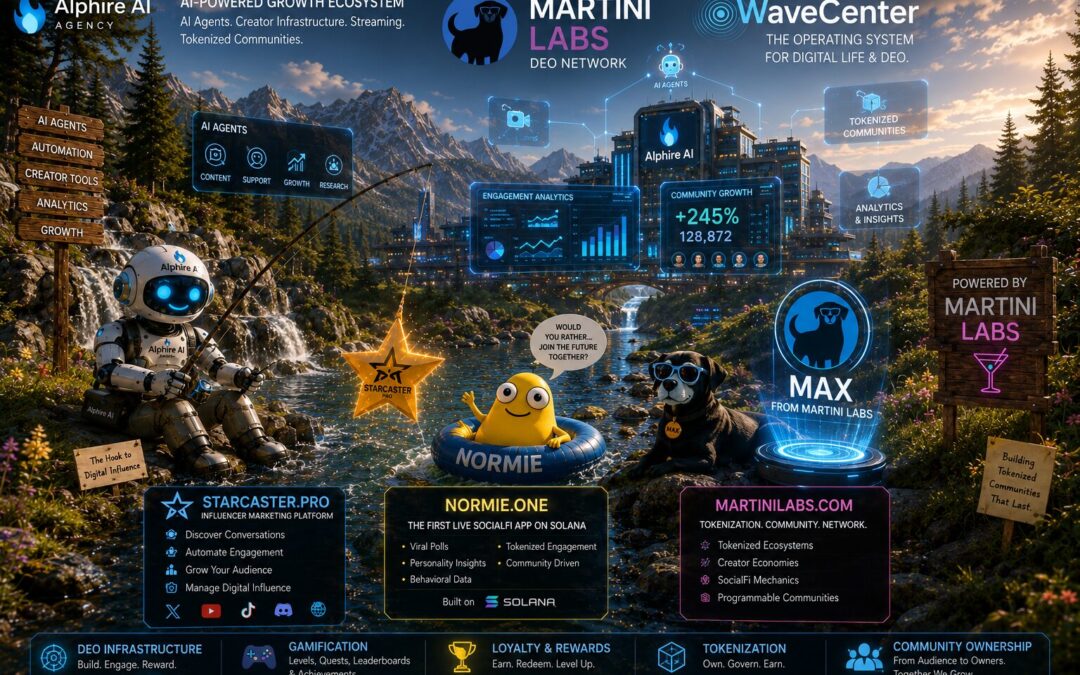
From Tokens to Tribes: How AI Vibe Coding and DEOs Are Creating the Next Digital Economy
Why the Future May Belong to Communities, Not Companies
For most of modern history, value creation followed a familiar pattern.
Companies built products.
Customers bought products.
Employees performed work.
Investors provided capital.
Shareholders received the rewards.
This model powered the industrial age and later the information age. It produced some of the largest and most successful organizations in history.
But a profound shift is underway.
Artificial intelligence is dramatically reducing the cost of creating software, content, products, services, and even entire businesses. At the same time, blockchain technology and tokenization are creating entirely new ways to organize people, distribute value, and coordinate communities.
When these forces converge, they create something much larger than another technology trend.
They create the foundation for a new economic model.
One built around participation.
One built around engagement.
One built around communities.
One built around ownership.
At Martini Labs, we believe this emerging model may become one of the defining innovations of the AI era.
The Rise of AI Vibe Coding
Not long ago, launching a technology company required substantial resources.
A founder needed:
- Software developers
- Designers
- Product managers
- Infrastructure specialists
- Marketing teams
- Significant funding
Today, AI Vibe Coding is changing that equation.
Using tools such as ChatGPT, Claude, Cursor, Windsurf, Lovable, Bolt, and Replit, individuals can increasingly describe what they want in plain language and collaborate with AI systems to bring those ideas to life.
Applications that once took months to build can now be prototyped in days.
Entire workflows can be automated.
AI agents can perform research, content creation, customer support, data analysis, and software development.
The result is a dramatic expansion of who can build.
Entrepreneurs who never learned traditional programming can now launch software products.
Creators can build platforms.
Communities can build tools.
Ideas can move faster than ever before.
This is not simply a productivity improvement.
It is a democratization of innovation.
Why Communities Are Becoming More Valuable
If AI reduces the cost of building products, what becomes scarce?
People.
Attention.
Trust.
Belonging.
Community.
The ability to gather and coordinate human beings around a shared purpose may become one of the most valuable assets in the world.
The internet spent decades optimizing for content.
The next phase may optimize for participation.
The most successful platforms increasingly understand that engagement itself creates value.
Every vote.
Every contribution.
Every referral.
Every piece of content.
Every recommendation.
Every interaction strengthens the network.
Historically, most of that value flowed to platform owners.
The next generation of systems may distribute value differently.
Enter the DEO
The Decentralized Engagement Organization.
A DEO is a framework for organizing communities around participation, contribution, and shared value creation.
Traditional organizations reward ownership of capital.
DEOs reward ownership of engagement.
The idea is simple.
People who help create value should have an opportunity to benefit from the value they help create.
Contributors become stakeholders.
Participants become partners.
Communities become ecosystems.
Instead of asking:
“Who invested money?”
A DEO also asks:
“Who invested effort?”
“Who contributed ideas?”
“Who helped grow the network?”
“Who helped build the culture?”
In an increasingly automated world, these human contributions become more important, not less.
Tokenization Changes Everything
Tokenization is often misunderstood.
Many people think tokenization is simply about speculative cryptocurrencies.
The larger opportunity is much more interesting.
Tokenization allows value, reputation, access, rewards, ownership, credentials, and participation to become digitally programmable.
Imagine a community where members earn rewards for:
- Creating content
- Helping newcomers
- Referring users
- Participating in governance
- Sharing expertise
- Building tools
These actions can be recognized, tracked, and rewarded.
Not through spreadsheets.
Not through manual processes.
But through programmable systems.
Tokens become the infrastructure layer that enables participation to become measurable.
This creates entirely new incentive structures that traditional organizations could never easily implement.
The Tokenization of Reputation
One of the most fascinating opportunities is the tokenization of reputation.
Historically, reputation has been difficult to quantify.
You might be a valuable contributor, but there was no portable way to demonstrate your contributions across communities.
Blockchain-based systems create new possibilities.
Reputation scores.
Achievement credentials.
Community rankings.
Contribution histories.
Skill certifications.
Participation records.
These systems may eventually become as important as resumes.
In some communities, they may become more important.
AI Agents Meet Tokenized Communities
Now imagine combining AI agents with tokenized ecosystems.
AI agents can:
- Welcome new members
- Moderate discussions
- Create content
- Analyze engagement
- Recommend rewards
- Identify contributors
- Manage loyalty systems
A community that once required a large operational team can increasingly operate with a network of specialized AI agents.
These agents become force multipliers.
They reduce friction.
Increase engagement.
Improve onboarding.
Enhance member experiences.
And help communities scale far beyond what was previously possible.
This creates an entirely new category of organization.
Communities powered by both humans and intelligent software.
The Participation Economy
The industrial economy rewarded labor.
The information economy rewarded knowledge.
The AI economy may increasingly reward participation.
As automation expands, society will continue searching for new ways to create meaning, opportunity, and economic value.
Communities may become the new companies.
Engagement may become the new equity.
Reputation may become the new resume.
Participation may become the new ownership model.
These ideas may sound radical today.
But many transformative innovations seem obvious only in hindsight.
Where Martini Labs Fits
Martini Labs operates at the intersection of several powerful trends:
- Artificial Intelligence
- Tokenization
- Community Building
- Creator Economies
- Digital Ownership
- Engagement Systems
- Future Organizations
The opportunity is not simply to create new technologies.
The opportunity is to create new structures for human coordination.
New incentive systems.
New ownership models.
New forms of collaboration.
New economic ecosystems.
Technology changes.
Platforms evolve.
Tools come and go.
But the desire to belong, contribute, create, and participate remains constant.
The organizations that understand this principle may define the next era of the internet.
Looking Ahead
The next decade will likely produce thousands of AI-powered communities, creator ecosystems, tokenized networks, and participation-driven organizations.
Some will fail.
Some will evolve.
A few may become incredibly influential.
The builders who succeed will not simply understand technology.
They will understand people.
They will understand incentives.
They will understand community.
And they will recognize that the greatest opportunity of the AI age may not be replacing humans.
It may be empowering them.
AI Vibe Coding is making it easier than ever to build.
Tokenization is making it easier than ever to reward participation.
DEOs are creating a framework for aligning communities around shared value creation.
Together, they may represent one of the most important economic shifts of the 21st century.
The future may not belong to the largest companies.
It may belong to the most engaged communities.
From Tokens to Tribes Part 2
The DEO Stack: How AI, Communities, Gamification, and Tokenization Converge
In Part 1, we explored how AI Vibe Coding, tokenization, and Decentralized Engagement Organizations (DEOs) may reshape the future of value creation.
But what does a DEO actually look like in practice?
What technologies power it?
How do communities grow?
How are rewards distributed?
How do loyalty and participation become measurable?
The answer lies in what we call the DEO Stack.
Just as traditional businesses rely on accounting systems, CRMs, payroll software, and management structures, DEOs require an entirely new technology stack designed around participation.
This stack combines AI, gamification, tokenization, community infrastructure, and intelligent automation into a unified ecosystem.
The DEO Stack
At a high level, every successful DEO needs five core layers:
Community
The people.
Engagement
The interactions.
Intelligence
The AI systems.
Incentives
The rewards.
Ownership
The tokenization layer.
When these systems work together, communities become living economic ecosystems.
 WaveCenter: The Operating System for Digital Life
Most people today live fragmented digital lives.
Their communications are in one platform.
Their projects are somewhere else.
Their communities exist in multiple applications.
Their data is scattered across dozens of services.
WaveCenter envisions something different.
A unified digital operating system where people can manage:
- Projects
- Communities
- Communications
- AI assistants
- Personal knowledge
- Data ownership
- Collaboration
- Digital assets
WaveCenter can become a foundational layer for DEOs because participation requires coordination.
Communities need a place to gather.
Projects need a place to evolve.
Contributors need a place to collaborate.
AI agents need a place to operate.
As DEOs grow, platforms like WaveCenter may become the command centers that connect people, data, AI, and engagement.
Alphire AI: The Intelligence Layer
Every modern organization needs intelligence.
Traditionally, intelligence came from employees.
Tomorrow, intelligence increasingly comes from AI agents.
Alphire AI represents the intelligence layer of the DEO stack.
Imagine a community powered by specialized agents:
Growth Agent
Tracks community growth.
Identifies opportunities.
Recommends expansion strategies.
Content Agent
Creates articles.
Generates social media content.
Produces newsletters.
Research Agent
Monitors markets.
Tracks competitors.
Analyzes trends.
Engagement Agent
Encourages participation.
Recognizes contributors.
Suggests rewards.
Community Success Agent
Onboards members.
Answers questions.
Improves retention.
Together these agents function like an AI workforce operating alongside human contributors.
The result is a more scalable and more responsive community ecosystem.
Starcaster Pro: The Distribution Layer
One of the biggest challenges facing any community is growth.
The best products in the world fail if nobody discovers them.
The best communities fail if nobody joins them.
The best ideas fail if nobody hears them.
This is where distribution becomes critical.
Starcaster Pro addresses one of the most valuable assets in the modern economy:
Attention.
By helping communities connect with creators, influencers, audiences, and distribution networks, Starcaster Pro becomes a growth engine for DEOs.
In a participation economy, influence itself becomes infrastructure.
The ability to attract members, activate contributors, and amplify engagement can determine whether a community thrives or stagnates.
Every DEO ultimately requires a distribution strategy.
Starcaster Pro provides the tools to accelerate that process.
 Normie: The Engagement Layer
Engagement is the fuel of every DEO.
Without engagement, there is no participation.
Without participation, there is no value creation.
This is where Normie becomes particularly interesting.
Normie is built around a deceptively simple concept:
People love sharing opinions.
People love comparing perspectives.
People love learning about themselves and others.
Through polls, personality frameworks, behavioral insights, and community interaction, Normie transforms engagement into measurable participation.
Every vote becomes data.
Every interaction becomes signal.
Every contribution helps create collective intelligence.
Normie demonstrates a key DEO principle:
Engagement itself is valuable.
Not because of advertising.
Not because of clicks.
But because participation creates community.
Gamification: The Engine of Participation
One of the greatest opportunities for DEOs lies in gamification.
Humans are naturally motivated by:
- Progress
- Recognition
- Achievement
- Status
- Belonging
Traditional businesses rarely leverage these motivations effectively.
DEOs can.
Imagine communities built around:
Experience Points (XP)
Members earn points through participation.
Levels
Participants advance through tiers.
Explorer.
Contributor.
Builder.
Ambassador.
Architect.
Achievements
Badges recognize milestones and accomplishments.
Quests
Tasks encourage valuable behaviors.
Leaderboards
Recognition creates friendly competition.
Reputation Scores
Trust becomes measurable.
These systems transform passive audiences into active communities.
Loyalty Programs Become Community Economies
Traditional loyalty programs reward purchases.
DEOs reward participation.
This difference is profound.
Imagine earning rewards for:
- Helping newcomers
- Creating content
- Referring friends
- Attending events
- Completing educational challenges
- Supporting community initiatives
Instead of customer loyalty programs, DEOs create participation loyalty programs.
This creates deeper relationships and stronger network effects.
Tokenization as the Reward Layer
Gamification creates motivation.
Tokenization creates ownership.
The combination is powerful.
Members may earn:
Utility Tokens
Access, governance, rewards.
Reputation Tokens
Proof of contribution.
Achievement NFTs
Milestones and accomplishments.
Community Equity
Participation-based ownership opportunities.
This is where Martini Labs sees enormous opportunity.
Tokenization enables digital communities to recognize and reward value creation at scale.
What once required manual administration can become programmable.
The Flywheel Effect
The most successful DEOs will likely operate through a simple flywheel.
Community creates engagement.
Engagement generates data.
AI analyzes the data.
Gamification encourages participation.
Participation earns rewards.
Rewards strengthen loyalty.
Loyalty grows community.
The cycle repeats.
Each layer reinforces the next.
Over time, the ecosystem becomes stronger, smarter, and more valuable.
The Next Generation of Organizations
The future may not be defined by isolated applications.
It may be defined by interconnected ecosystems.
WaveCenter coordinates.
Alphire AI provides intelligence.
Starcaster Pro drives growth.
Normie drives engagement.
Martini Labs enables tokenization and digital ownership.
Together these components represent more than individual products.
They represent the architecture of the Participation Economy.
An economy where value is created not simply through labor or capital, but through engagement, contribution, creativity, collaboration, and community.
The organizations that master these principles may become the most influential organizations of the AI era.
The future belongs to builders.
But increasingly, the most successful builders may not be building companies.
They may be building communities.
The DEO Playbook
How to Launch a Decentralized Engagement Organization Using AI Vibe Coding, AI Agents, Gamification, Loyalty Systems, and Tokenization
The next generation of successful organizations may not look like traditional companies.
They may not have large offices.
They may not have hundreds of employees.
They may not even begin with outside investors.
Instead, they may begin with something far more powerful:
A community.
A mission.
A shared purpose.
And a system that transforms participation into value.
Welcome to the DEO Playbook.
A practical framework for building a Decentralized Engagement Organization using AI Vibe Coding, artificial intelligence, gamification, loyalty systems, and tokenization.
The tools now exist.
The technology is ready.
The question is no longer whether DEOs can be built.
The question is who will build them first.
Step 1: Start with a Mission, Not a Product
Most startups begin by asking:
“What product should we build?”
DEOs begin differently.
They ask:
“What community should exist?”
The strongest DEOs are built around identity.
People join because they believe in something.
Examples include:
- AI builders
- Content creators
- Investors
- Gamers
- Athletes
- Travelers
- Students
- Entrepreneurs
- Scientists
- Health enthusiasts
People don’t join products.
People join tribes.
The mission is the foundation.
Everything else is built on top.
Step 2: Design the Community
Before building technology, define the community.
Answer:
Who belongs?
Why do they participate?
What behaviors should be encouraged?
What outcomes create value?
The most successful communities create a clear path from newcomer to leader.
For example:
Visitor
↓
Member
↓
Contributor
↓
Builder
↓
Ambassador
↓
Architect
This progression becomes the basis for future rewards and recognition.
Step 3: Use AI Vibe Coding to Build Fast
Historically, building a platform required development teams.
Today, founders can launch rapidly using AI.
Tools include:
- ChatGPT
- Claude
- Cursor
- Windsurf
- Lovable
- Bolt
- Replit
Using AI Vibe Coding, founders can build:
- Websites
- Community portals
- Leaderboards
- Reward systems
- Mobile applications
- AI agents
- Dashboards
- Referral systems
A small team can now create what previously required a startup budget.
The barrier to innovation has collapsed.
Step 4: Build Your AI Workforce
Every DEO should think beyond human staffing.
Instead of asking:
“Who should I hire?”
Ask:
“What AI agents should I deploy?”
Community Agent
Responsibilities:
- Welcome users
- Answer questions
- Guide onboarding
Available 24/7.
Content Agent
Responsibilities:
- Blog posts
- Social content
- Newsletters
- Community updates
Growth Agent
Responsibilities:
- Referral campaigns
- User acquisition
- Influencer outreach
- Community growth
Engagement Agent
Responsibilities:
- Identify inactive users
- Recommend challenges
- Suggest activities
Loyalty Agent
Responsibilities:
- Award points
- Track achievements
- Recommend rewards
AI agents become the operational backbone of the organization.
Step 5: Gamify Everything
Participation is not automatic.
People need reasons to engage.
Gamification provides those reasons.
Think like a game designer.
Not a software company.
XP System
Users earn points for:
- Posting
- Commenting
- Voting
- Referrals
- Contributions
Levels
Examples:
Level 1 Explorer
Level 2 Contributor
Level 3 Builder
Level 4 Creator
Level 5 Ambassador
Level 6 Architect
Humans naturally pursue progress.
Quests
Encourage behaviors that strengthen the ecosystem.
Examples:
Invite 5 friends.
Complete a challenge.
Publish content.
Attend an event.
Help a new member.
Leaderboards
Recognition is often more valuable than money.
People enjoy being seen.
The best DEOs celebrate contributors.
Step 6: Build a Loyalty Engine
Traditional businesses create customer loyalty.
DEOs create community loyalty.
There is a difference.
Customers buy.
Community members participate.
Reward participation.
Reward consistency.
Reward contribution.
Reward leadership.
Reward collaboration.
Loyalty becomes a measurable asset.
Step 7: Tokenize Participation
This is where things become interesting.
Imagine rewarding:
- Referrals
- Content creation
- Community support
- Learning
- Collaboration
- Governance
Using tokens.
Tokens allow communities to recognize value creation at scale.
Possible models include:
Utility Tokens
Used for:
- Access
- Rewards
- Governance
- Unlockables
Reputation Tokens
Represent:
- Trust
- Expertise
- Contributions
Achievement NFTs
Represent:
- Milestones
- Certifications
- Special accomplishments
Community Ownership
Perhaps the most powerful model.
Members who help build value may earn a stake in future success.
This transforms audiences into stakeholders.
Step 8: Create the Engagement Flywheel
The strongest DEOs operate through compounding loops.
Community drives participation.
Participation creates data.
AI analyzes behavior.
Gamification increases activity.
Activity generates rewards.
Rewards strengthen loyalty.
Loyalty grows community.
The cycle repeats.
Every loop makes the ecosystem stronger.
The DEO Ecosystem Vision
A mature DEO ecosystem may consist of multiple specialized platforms working together.
WaveCenter
The operating system.
Where communities, communication, projects, AI, and data converge.
The digital headquarters.
Alphire AI
The intelligence layer.
AI agents powering growth, automation, marketing, support, and engagement.
The digital workforce.
Starcaster Pro
The distribution layer.
Connecting communities with creators, influencers, and audiences.
The growth engine.
Normie
The engagement layer.
Polls.
Behavioral intelligence.
Personality systems.
Community participation.
The social graph.
Martini Labs
The tokenization layer.
Digital ownership.
Community rewards.
Incentive systems.
Participation economies.
The value layer.
The Next Great Opportunity
The internet spent the last twenty years optimizing for content.
The next twenty years may optimize for participation.
People increasingly want:
- Ownership
- Recognition
- Purpose
- Community
- Collaboration
Artificial intelligence makes building easier.
Tokenization makes rewarding easier.
Gamification makes participation more engaging.
DEOs align all of these forces.
This is why the opportunity is so large.
Not because AI is replacing people.
But because AI allows people to build communities that were previously impossible to create.
The Future Belongs to Builders
The next billion-dollar organizations may not begin as corporations.
They may begin as communities.
A Discord server.
A creator audience.
A gaming guild.
A learning network.
A fan base.
A movement.
AI Vibe Coding gives founders the power to build.
AI Agents give communities leverage.
Gamification creates engagement.
Loyalty creates retention.
Tokenization creates ownership.
DEOs bring everything together.
The builders who understand this shift early may help define the next era of the internet.
The future may not belong to companies.
The future may belong to communities.
And communities, powered by AI and aligned through participation, may become the most valuable organizations in the world.
